I was talking with a customer recently and he asked me what part of managing projects I find most challenging. I thought for a moment, and I told him, “It’s managing the conflicting needs of people affected by the project.”
Conflicting Interests
I am an engineer at heart, so when a problem arises, my first thoughts are technical solutions and alternatives and the tradeoffs involved in each. My “engineering-first” approach works well when you’re working on a challenge that is fundamentally technical. However, as project managers, some of our most important questions are “political” in nature, meaning that our projects affected by power dynamics of different people involved and their sometimes-conflicting interests. Think of the tradeoffs between a local government that wants to build a new power plant and the property owners near the proposed site. Neither side is “bad”, but they have different interests, which can get in the way of a project’s progress.
Understanding dynamics between people, what their interests are, and anticipating conflicts is something that I have had to learn over time, occasionally through failure. And based on conversations with other project managers, I am not alone in this, especially among PM’s from technical backgrounds.
In this post, I want to introduce Stakeholder Mapping, one of the tools project managers use to help better understand a project’s various stakeholders and what their interests are, so that PM’s can better engage with them to fulfill your own interests as a PM: Deliver successful projects (see note 1).
Mapping Stakeholders
Stakeholder Mapping begins with listing out everyone affected by your project, whether positively or negatively, both inside the organization and outside; this list is called a Stakeholder Register. And for each stakeholder, rank their Influence or Power (i.e. how much they can affect your project) and their Interest (i.e. how much stake they feel they have in the outcome of your project). Score their Influence and Interest–I use a 1-5 scale, but you could easily use High, Medium, or Low.
Here’s the benefit of this tool: The Influence/Interest rankings you assign to each stakeholder can help guide the strategy you use to engage with them. There are different opinions on exactly how to articulate the strategies, but here’s what I suggest:
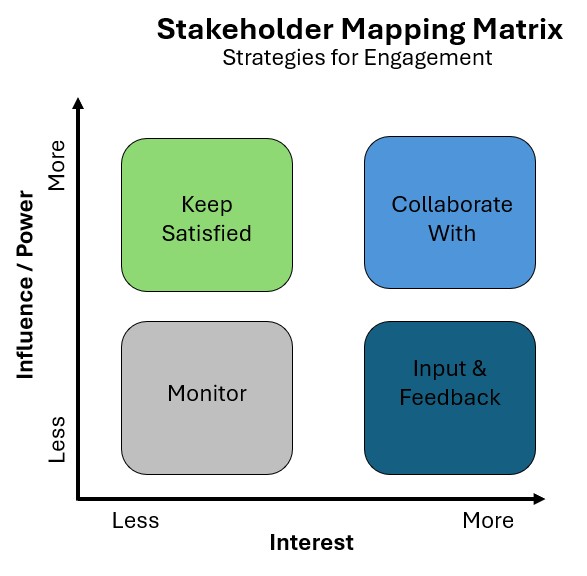
1.Collaborate With (High Influence, High Interest) – Work closely with these stakeholders in your daily work. Their opinion matters most, and they can help you the most if there is alignment between you.
2.Keep Satisfied (High Influence, Low Interest) – Understand their needs. Be careful that your project doesn’t negatively impact them. Sometimes they have more interest than you immediately know.
3.Input & Feedback (Low Influence, High Interest) – An example here is the end users of a product you’re developing. Get their input and feedback, and keep them informed, but you’re not working personally with them every day. Seek alignment between their interests and the “Collaborate With” group.
4.Monitor (Low Influence, Low Interest) – No need to actively engage with these. But watch to see if their interest or influence grows over the course of the project.
What’s the Gain?
Kelsey Arpaio with the Digital Project Manager summarizes her research on the effect of office politics on project management saying that effective project managers should focus on seeing problems coming:
Good PMs know the dynamics. They see where things could get political, and they plan around it. So work on getting better at:
- Spotting the personalities that could become blockers
- Anticipating competing agendas
- Building alignment early, so you don’t have to fight for it later
The outcome of effective stakeholder engagement is better working relationships with people who have power to influence your project, and more value delivered for those who use your project. And possibly fewer headaches in making that happen.
Notes
(1) This post adapts principles from seminar: “‘Herding Cats’- Strategic Program Execution Via Effective Executive Stakeholder Management” by Bob Kermanshahi on December 10, 2019. Recording hosted at ProjectManagement.com.

 Ithaca Global Project Consultants
Leave a comment